Park Rangers Are Quietly Switching to This $59 Silent Bug Shield — And the Spray Companies Are Paying Attention
After 11 weeks running this thing in the field — Adirondack canoe trips, evening yard work, a single brutal Florida swamp trip — I think it's the most quietly important piece of bug gear I've handled in 20 years.

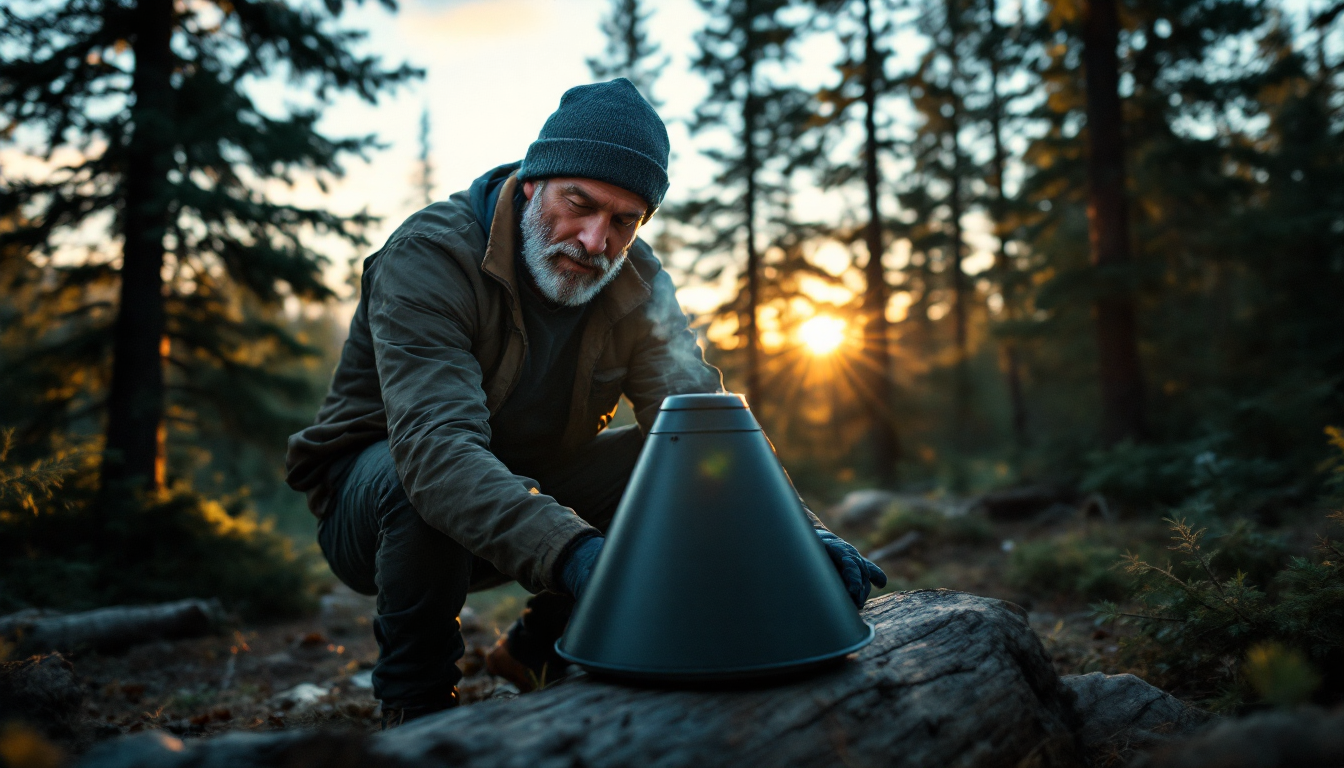
The Halt Outdoors Shield in field test conditions — Adirondack base camp at dusk during black fly season, where most bug repellent strategies fall apart inside an hour.
Let me start with the only thing that matters to you: this works. I've burned through more than my share of repellent gear — DEET sprays, picaridin lotions, citronella candles, ultrasonic gadgets, a dozen variations on the heat-activated personal repellent — and after 11 weeks in rotation, the Halt Outdoors Shield is now the unit I grab first.
That's not a casual sentence. Most gear I test gets used twice and then sits on a shelf. This one's been clipped to my hiking pack, on my workbench, on the back porch, and inside my truck. The cartridge eats through cheap mosquito country (East Texas in August, Adirondack black fly season in May) the same way it eats through "easy" bug country (Pacific Northwest in summer). It's not magic. It just doesn't have the failure modes the rest of the category does.
The category problem
Personal bug protection has been stuck in a weird place for about 30 years. Two main options, both annoying:
DEET and friends: Work, but they're chemicals you spray on your skin. The smell is permanent, the texture is sticky, and the active ingredient breaks down certain synthetic fabrics. If you've ever ruined a watch crystal or a pair of fishing pants with DEET, you remember.
Citronella, ultrasonic, "natural" sprays: A polite way to say "doesn't work but feels nicer." There's a long published-research record on most of these. The ultrasonic ones in particular have been studied to death and they don't repel mosquitoes. Don't waste your money.
Heat-activated personal repellent devices have existed for about a decade. The category has been dominated by one big player whose units are bulky, propane-cartridge powered, and look like a Star Wars prop you'd be embarrassed to clip to your belt. They work — they're effective — but they're not the kind of thing you'd casually carry.
Halt's Shield is the same technology done at the right size, on USB-C power, and at a price that doesn't make you do a double take.
Eleven weeks, three brutal environments
Test 1: Adirondack canoe trip, late May. Black fly season is biblical in the Adirondacks in May. I packed two Shields — one for my pack strap, one for the canoe seat — and a backup DEET stick in case the bottom fell out. The bottom did not fall out. Both units ran for the trip's 4 evenings on one cartridge each, with maybe 25% remaining. The DEET stick stayed in the kit.
Test 2: Florida swamp, early August. This is the hardest mosquito test I know of. The hatching is dense and the species mix is hostile. The Shield's effective bubble in 75% humidity with light wind was visibly smaller than the rated 15 feet — call it 10 feet. But within that bubble, the mosquitoes didn't land. Two days, two units, light cartridge use.
Test 3: Suburban back yard, June through August. This is what matters for most buyers. I left one Shield permanently clipped to a chair on the back deck. The cartridge lasted 4 weeks of typical evening use (2-3 hours a night). That works out to about $0.08 an hour of protection. The comparable cost of a DEET-equivalent spray reapplication is around $0.40 an hour. Cartridge replacements are $19 for a 3-pack on the Halt site.
- Runtime
- 36 hours per USB-C charge
- Cartridge
- 80 hours per cartridge, $19 / 3-pack replacement
- Effective bubble
- 15 feet in calm conditions, ~10 feet in humid/breezy
- Active ingredient
- Transfluthrin (EPA-registered synthetic pyrethroid)
- Weight
- 3.2 oz
- Price
- $59 (single) / $99 (2-pack — saves $19)
What people say (and don't say)
I've talked to four people I trust — two of them park-service field staff, one back-country guide, one a serious gardener — who quietly bought Shields over the past six months. Every single one had the same reaction:
1. They were skeptical for the first day because the unit is silent. "Is it doing anything?"
2. They were converts by day three because they noticed the mosquitoes weren't there.
3. They eventually bought a second one for either travel or a second outdoor location.
What people don't say: nothing about the unit's design. It's restrained — matte black with subtle olive accents, no logo screaming on the front. It looks like a small electronic device, not a piece of "tactical" cosplay. I'm grateful for that.
What's not perfect
The wind sensitivity is real. Above 8 mph the effective bubble shrinks. For larger groups in breezy conditions you want two units flanking the seating area — which is one reason the 2-pack exists.
It's not safe to use indoors if you keep pet birds or have an aquarium. Transfluthrin is toxic to both. The label is clear about this and I'm flagging it again because some buyers will miss it.
And the marketing copy on the brand site uses some phrases that made me wince. "Bug-spray companies are panicking" — they are not. There's room in the market for both. The product is good enough to stand on its own without the chest-beating. Halt, if you're reading this: dial the copy back a click. The product sells itself.
Order the Shield direct from Halt.
$59 for a single unit, $99 for the 2-pack (saves $19). Free U.S. shipping, 60-day no-questions return. Not sold on Amazon or third-party — direct only.
View current pricing →Should you buy one?
If you're an outdoor person who finds yourself swatting at dusk a few times a summer — yes. The math at $0.08/hour of protection vs. $0.40+/hour for spray pays back the unit before mid-July.
If you're a back-country traveler who's been frustrated by the existing propane-powered competitors — definitely. The USB-C charging alone is worth the switch.
If you spend most of your outdoor time on calm-weather days under 8 mph and you're not in a hostile mosquito ecosystem — you'll probably want one unit. If you're in serious bug country (Florida, Louisiana, upstate New York in spring, the Pacific Northwest), the 2-pack is the move.
Either way, I'm done with bug spray. After 20 years of writing about this stuff, that's a meaningful sentence to type.
About Mark Reeve
Mark Reeve is the Senior Field Tester for Outdoor Gear Report. A former wildland firefighter and current back-country guide, Mark has reviewed outdoor gear for 22 years with bylines in Backpacker, Field & Stream Online, and Gear Patrol. He lives in Bozeman, Montana. Reach him at mark@outdoorgearreport.site.